

Chapter 2
IN THIS LESSON
The Journey of a Forgotten Item: From Bin to Horizon
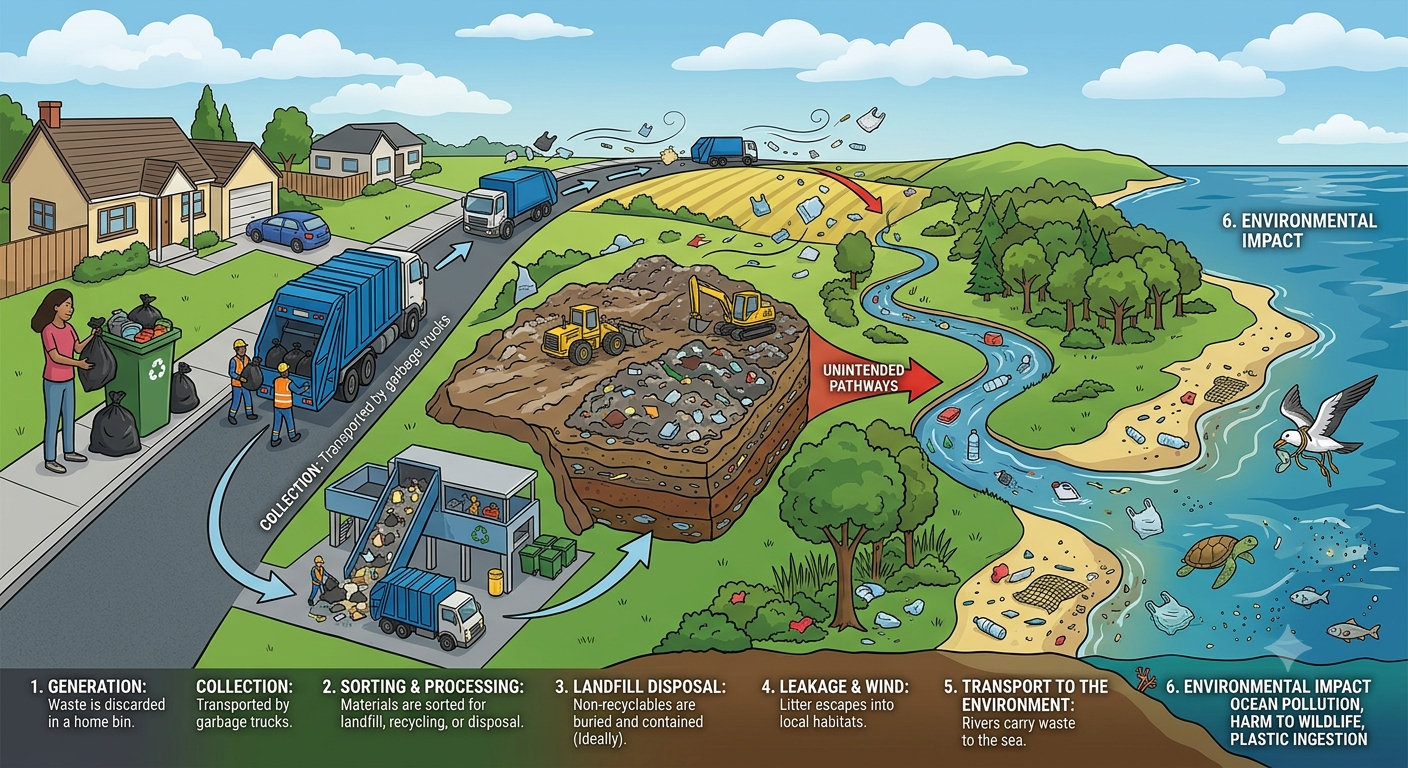
It started in the kitchen—a simple, crinkly plastic wrapper that once held a quick snack. When it was finished, it was tossed into the bin without a second thought. To the person who dropped it, that was the end of the story. But for the wrapper, the journey was just beginning.
The Collection
Early the next morning, the heavy roar of a truck broke the silence. A mechanical arm lifted the bin, and the wrapper tumbled into the dark, chaotic belly of a collection truck, pressed tightly against discarded papers, food scraps, and other forgotten objects. It was a chaotic ride through winding streets, the truck stopping and starting as it gathered more of society's remnants.
The Sorting
The truck arrived at a massive sorting facility. Here, the chaos turned into a rhythmic dance. The wrapper flew along high-speed conveyor belts, passing under powerful magnets, optical scanners, and air jets designed to separate the valuable from the refuse.
However, the wrapper was lightweight, thin, and mixed with sticky residue. The machines weren't designed to capture it. It slipped past the sensors, falling through a gap in the conveyor, and was diverted into a pile designated for the landfill.
The Unintended Path
The landfill was a massive landscape of earth and engineered layers. But landfills aren't hermetically sealed voids. As the waste was compacted and dumped, a sudden gust of wind—a common occurrence in the open expanse—picked the flimsy plastic wrapper up. It danced through the air, escaping the landfill’s perimeter and tumbling into the tall grass of the surrounding fields.
It was now litter.
Into the Environment
Rain arrived, washing the wrapper from the field into a nearby storm drain. It traveled through underground pipes, dark and echoing, until it was spat out into a local creek. The water was stronger than it looked, carrying the wrapper downstream. The creek widened into a river, and the river eventually kissed the salt of the ocean.
The wrapper was no longer trash in a bin; it was part of the marine environment. It floated on the surface for days, the sun beating down on it, causing it to become brittle and eventually break into smaller, jagged fragments known as microplastics.
A sea turtle, mistaking the drifting piece of colorful plastic for a jellyfish, took a bite. The journey that began in a suburban kitchen had ended, far from human eyes, deep within the ecosystem we all share.
The wrapper's journey serves as a sobering reminder: There is no "away" when we throw things away. Every item has a destination, and our choices at the point of disposal ripple far beyond the bin.
Would you like to explore some practical, everyday strategies to help keep waste from reaching the environment?
-
Add a short summary or a list of helpful resources here.